The Misses That Keep Your Patients From Returning to Performance
Most of us can make a patient feel better on the table. Far fewer can get them back to the level they performed at before the injury — or beyond it — and make those changes last. That gap is where the biggest misses in physical therapy live, and on a recent KIMEcast Deep Dive the conversation worked through them one by one. None of them are exotic. They’re the ordinary defaults we stop questioning.
Miss #1: Treating the tissue while ignoring the threat
When a patient gets hurt, the injury registers in the brain as threat before they can process it cognitively. The limbic system runs ahead of reason, and the fear that shows up is almost always the same: Is this going to last forever? Will I run again without pain? Is my sport gone? Fear and pain sit in the same category, and both inhibit the muscle. You can prescribe all the right exercises, but if you don’t address the fear, the quality of the rep drops — you get a half contraction, poor recruitment, and avoidance patterns instead of adaptation.
“What’s the opposite of fear? It’s hope and faith that your future is somewhat within your control.”
Old-school PT tried to be the answer through manual therapy — I’ll fix you, you’ll feel better. New-age PT swung to data and benchmarks. Both miss the same thing: neither battles fear. The antidote is hope, delivered as a concrete plan that hands control back to the patient, with you acting as the guide on the journey rather than the hero of it.
Miss #2: “If it hurts, don’t do it”
Tissue requires a signal to adapt. The hosts put it bluntly: being still is a zero signal. Unloaded stem cells injected into muscle migrate or differentiate into something else — they don’t become muscle without a load signal. The reflexive ‘if it hurts, back off’ instinct, applied broadly, guarantees the body never adapts. A more useful frame: if the first set is uncomfortable and the second set feels better, that’s an immediate neurological adaptation and a green light. If it gets worse set over set, punt that movement two weeks — not for life.
This is where dosing matters. Pattern reps without load only teach a pattern. To drive adaptation you have to push into roughly 60–75% (RPE ~7/10, 8–12 reps), and you have to coach the last hard reps of the last set. If the set isn’t hard, there isn’t enough load to change the tissue — and after a significant injury, where there’s muscle atrophy there’s tendon and bone atrophy too.
Miss #3: Wasting the 8-to-16-week window
There’s a second wave of healing, roughly 6 to 16 weeks out, that is the prime strength-building opportunity — and it’s routinely squandered with ‘keep doing your exercises.’ Position it explicitly with the patient: this is your strength window, three to four days a week, here’s exactly how to load and progress. Build that foundation and the resilience available beyond the four-month mark is off the charts. Miss it and the patient crumbles later on running speed and explosiveness, even if they did all the ‘right’ exercises.
Miss #4: Forgetting the foot — and the spring
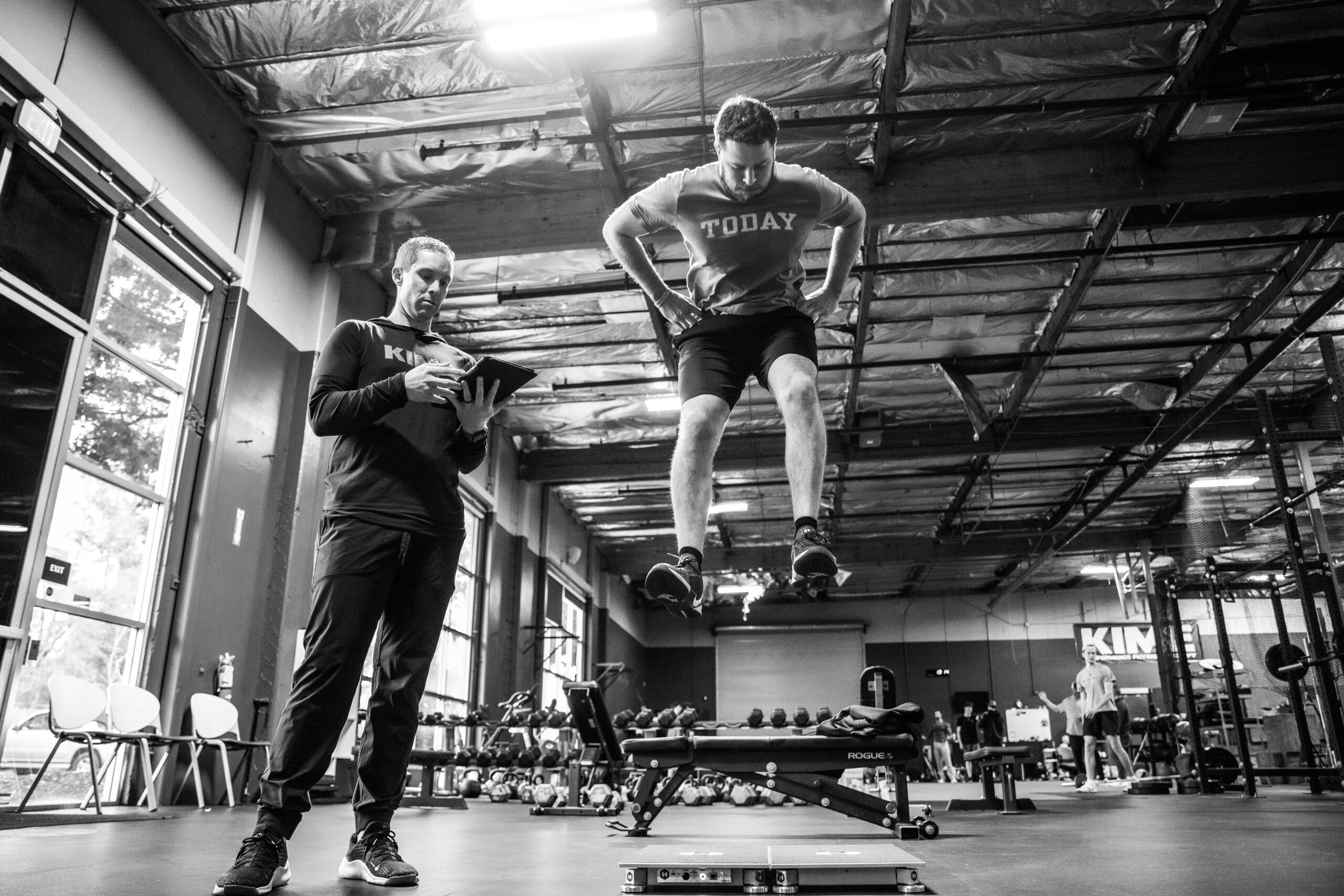
Speed progressions skip the part of the body that meets the ground first. Static, planted work — step-ups, leg press, open-chain — never trains the dynamic pronation/supination behavior a run or cut demands. On force plates, that failure shows up as an impact peak: a force spike about 50 milliseconds into a landing, meaning the muscles and tendons didn’t absorb anything and the load went straight to the joint. It may be the most potent early predictor of a future ACL injury we have. Spring-like behavior has to be taught before running, not assumed once a doctor says ‘cleared to run.’
Miss #5: Letting the protocol think for you
Protocols are written with wide safety margins so they can’t be run carelessly — which means understanding why a protocol exists tells you where it can be bent. Care has consistently moved toward loading earlier than tradition allowed: ACL patients went from six-week casts to day-one rehab, and the same logic now reaches Achilles and even cartilage care. The clinician’s job is to take the science and deploy it safely — know what to avoid, then load. As one surgeon discovered when his patients recovered faster after ditching the brace: patients are often successful despite our protocol, and you only learn that if you’re asking the questions.
The common thread
Every one of these misses is really one miss: defaulting to the protocol instead of coaching the person in front of you. The upgrade isn’t a new modality. It’s naming the fear, building hope into a visible plan, loading intelligently, and coaching the parts of the chain everyone else skips. That’s the standard of care worth building a career around.
Listen to the full Deep Dive on KIMEcast Episode 61 — The Biggest Misses in Physical Therapy | Hope, Strength & Return to Performance available on Spotify, Apple Podcasts, and YouTube.