


Kimeblog // By Tony Mikla
The Performance Continuum
July 2, 2026
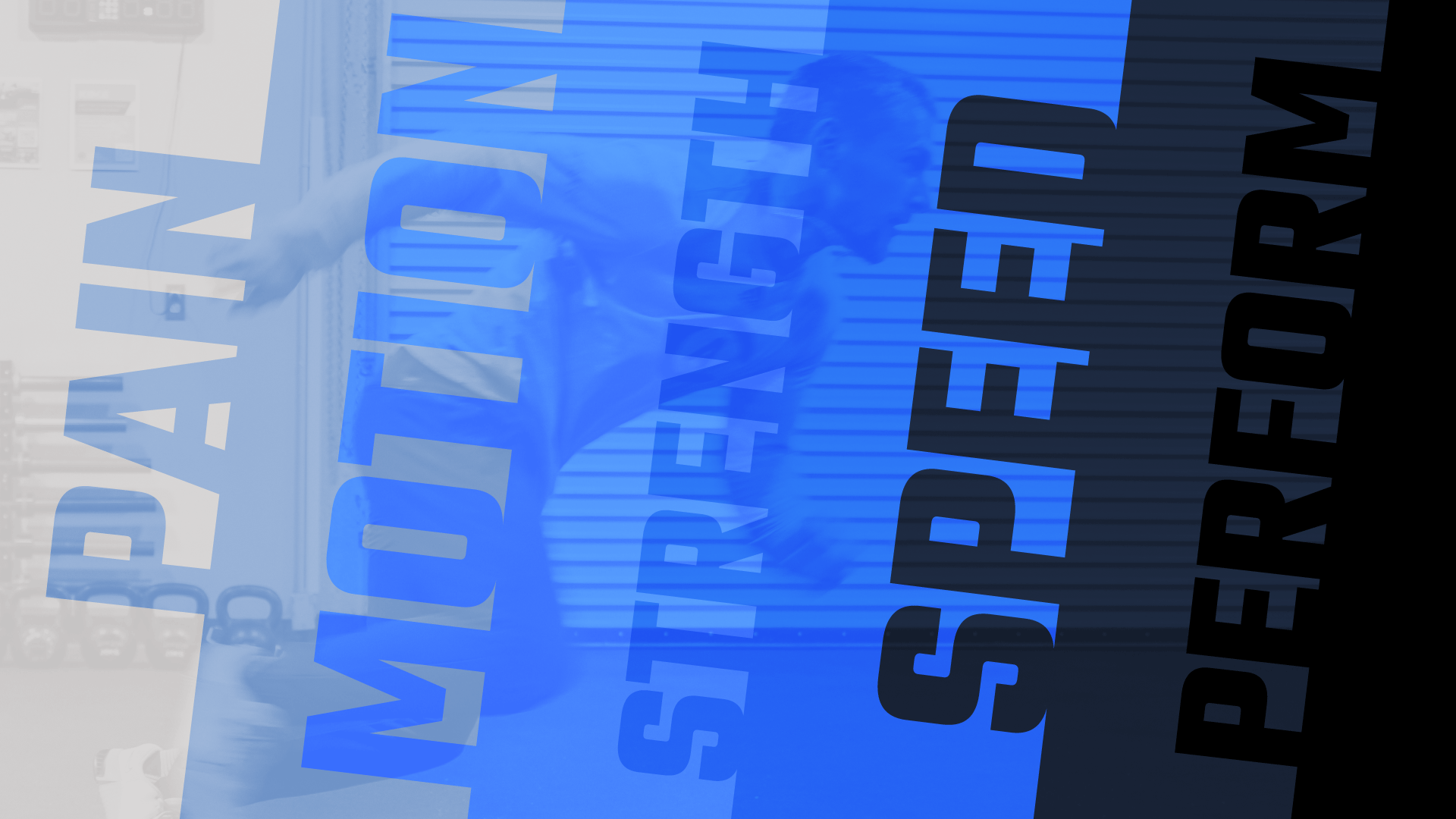
The Performance Continuum
Why rehab has to happen in this order — and what goes wrong when it doesn’t.
Any medical provider — physical therapist, athletic trainer, sports medicine physician, performance coach — is drowning in information. Mobility tests. Strength tests. Manual therapy options. Modalities. Injection options. Return-to-sport metrics. The literature changes every six months. The patient in front of you, sometimes, every six minutes.
The clinician who succeeds is not the one who knows the most. It’s the one who can sort it all into a clean order of operations and act on it. That order, in our practice, is the Performance Continuum. Five stages. Every patient sits somewhere on it the day they walk in. The clinician’s job is to find the leftmost box that’s still in play — the limiting factor — and treat that one thing first.
“Where are you at on this continuum? What’s the limiting factor, and in what box? That should really determine what we do.”
KIMEcast Ep 60 · 00:01:43
The five stages.
Pain and inflammation. Mobility. Strength. Speed and power. Performance. Each stage builds on the one before it. Skip a step and the structure underneath gives way the moment you load it.
Here’s how the limiting-factor discipline plays out in practice. A patient walks in with shoulder pain and a positive impingement test. The instinct — the one drilled into every clinician by school — is to test the rotator cuff. How strong is it? Where’s the weakness? What does the strength-to-stability ratio look like?
That whole battery is a waste of thought. The shoulder is inflamed. The cuff will test weak. It’s weak because it’s inhibited by pain. Measure it now and you’ve measured a snapshot that will look completely different in 10 minutes if the pain comes down. The limiting factor is the pain. Solve the pain. Reassess the cuff next visit, on the day the snapshot is actually meaningful.
This is the discipline the continuum imposes. Don’t try to solve a thousand things on one day. Solve the thing that’s limiting you now. Then find the next thing.
Stage 1: Pain. Two questions and the 3-to-5-day rule.
When a patient presents in pain, the first question to answer is whether the pain is inflammatory or mechanical. Inflammatory pain demands a different intervention — actually, almost the opposite intervention — from mechanical pain. Get the classification wrong on day one and the entire plan is built on the wrong foundation.
The diagnostic, in two questions: Are you in pain right now, sitting in front of me, at rest? How did you sleep last night — not five nights ago, not most nights, but last night?
Pain at rest is one plus sign. Sleep disturbance is another. Two plus signs and you’re almost certainly in inflammatory pain. The treatment is not to exercise the tissue. It’s to identify the trigger, remove it, and let the body do its work for 3 to 5 days. The 3-to-5-day rule resolves the inflammation for the overwhelming majority of cases that aren’t a disc.
This is also where the Advil question lives. Aggressive NSAID use in the first 4 days isn’t a free intervention. Inflammation is the healing signal. Blunt the signal and you blunt the response. Save the medication for cases that are reoccurring, chronic, or genuinely disabling — not as the first move.
Stage 2: Mobility. Why 95% is neurological.
Once the pain is down, the next question is whether the patient can move. And here’s the most clinically distinctive claim in the entire framework: in our experience, fewer than 5 percent of perceived joint restrictions are actually structural. Stiffness, scar tissue, frozen-joint diagnoses — in most of the cases that walk into a sports medicine clinic, those are not what’s happening at the tissue level.
What’s happening is neurological guarding. The body has decided the segment isn’t safe to move. It locks down. The patient feels it as tightness. The clinician palpates it as restriction. Neither of them is wrong about what they’re feeling — they’re wrong about what’s causing it.
“I don’t actually think that stiffness or scar tissue or joint restriction is very common in the body at the level it’s described. Less than 5 percent of the time, in my experience. The other 95 percent is neurological.”
KIMEcast Ep 60 · 00:12:53
The test is simple. Whatever the patient’s deficit is, can you cut it in half with 10 minutes of skilled manual therapy? If yes, you’re working with the nervous system. If not, you may be in the small percentage of cases where there’s genuine structural change. Either way, the test gives you the diagnosis in the first visit, not the fifth.
This matters because manual therapy works — but it opens a window. The window might last five minutes. It might last a week. It does not change the patient forever. The reload work that follows the window is what makes the change permanent.
Stage 3: Strength. Reset, Reprogram, Reload.
Once range is available, the work shifts to building the body’s ability to use it. The framework here is three words. Reset opens the range. Reprogram teaches the body to coordinate inside it. Reload locks the pattern in with progressive strength.
Most failed rehab cases — the patient who feels better, returns to activity, and is back in your clinic six weeks later — skip the reprogram step. Mobility came back. Load went on top. The old movement pattern came right back, because no one taught the body a new one. The reset opened a door the patient walked back through into the same room.
The reload step is also where the discipline of coaching the body in front of you replaces the discipline of running a protocol. Not every athlete needs to barbell-back-squat. Not every athlete needs a strict overhead press. Build the program around the body you’re working with, not the body the program assumes.
Stages 4 and 5: Speed and Performance. Look good and feel good.
The speed phase is where compensation gets exposed. A movement that looked clean at low load — a clean squat, a clean hinge, a clean press — frequently breaks down the moment velocity enters the picture. The body, given speed, reverts to whatever pattern got it through the original injury.
The test for whether an athlete is ready to return to sport, after speed: you have to look good, and you have to feel good. Either one without the other means the athlete isn’t ready. Looking good while feeling off means the body is hiding the dysfunction. Feeling fine while moving badly means the compensation pattern is intact and ready to drive the next injury.
“I love saying — I want you to look good and I want you to feel good. If you’re running with a limp, jumping only on one leg, afraid to load the other side, it is too soon.”
KIMEcast Ep 60 · 00:37:35
And when something looks wrong at speed, the answer is almost never “do more of it.” The body is smart. If you ask it to do a movement it can’t do cleanly, repeatedly, it will get better at compensating around the deficit. It won’t expose the broken segment, because the broken segment isn’t safe to expose. The answer, instead, is a simpler precursor drill — a feed-forward drill that isolates the broken segment and rebuilds the pattern before bringing it back to full speed.
The continuum as a report card.
There’s one more layer to the framework, and it has nothing to do with technique. When the pain resolves and the mobility returns, a lot of patients say a version of the same line: “I don’t really need to come back, thank you.”
That moment is the clinician’s failure, not the patient’s. The continuum is the report card. You don’t hand someone a C-minus and walk out. You hand them the report card, you show them the rest of the path to an A-plus, and you make sure they leave with hope and a plan. That conversation — the move from “your pain is gone” to “here’s the rest of what we’re going to do” — is what separates a competent treatment plan from elite clinical work.
The five stages exist for a reason. Each one builds on the one before it. The clinician who treats them in order is doing a fundamentally different job than the clinician who shotguns the toolbox at every patient. The patient feels the difference. So does the outcome.
Listen to the full conversation on KIMEcast Episode 60 — From Pain to Performance: The Rehab Continuum Explained. To learn more about how KIME applies this framework to your case, visit our website or book an evaluation.
Recent Blogs
Archives
Kimecast Channels


