


Kimeblog // By Tony Mikla
The Better the Athlete, the Better the Compensator
June 29, 2026
The Better the Athlete, the Better the Compensator
What 3,000 athletes taught us about re-injury, asymmetry, and the limits of “you’re cleared.”
There is one question Tony Mikla asks athletes when their data comes back asymmetrical. It has become a kind of running joke at KIME because it works so reliably.
“What did you do on your left side?”
And almost without fail, the athlete looks up, thinks for a second, and says: “Oh, I sprained my ankle about eight months ago.” Or twisted a knee. Or strained a hip. Something they thought or were told had long since “healed”.
It wasn’t. And after three thousand athletes screened, the pattern is consistent enough that the question has become a diagnostic of its own.
“We’ve tested 3,000 athletes over the last several years. And we find these deficiencies left to right. We have one question. What did you do on your left side?”
— Tony Mikla, DPT · KIMEcast Ep 59, 00:12:00
The body is built to survive, not built for soccer.
To understand why “healed” so reliably under-describes what is actually happening in an injured athlete, you have to start with what the body is doing while it heals. The tissue, of course, is repairing. The pain is fading. But the body — the broader system that has to keep functioning while one piece is offline — is busy doing something much more interesting. It is finding another way.
Compensation is not a bug. It is the central feature of how the human body survives injury. When a single joint, ligament, or muscle group is compromised, the system reroutes load through neighboring tissues. The hip takes more of the work the ankle used to do. The opposite leg covers for the involved leg. The thoracic spine starts rotating earlier and harder to make up for the pelvis that won’t. The athlete keeps moving. The body is built for that.
And here is the cruel part: the better the athlete, the better the compensator. Elite movers are elite precisely because they redistribute load brilliantly under stress. They will keep playing through deficits that would shut a less-trained body down. They will become starters in spite of their body, not because of it. Their gift is what hides the problem.
The 22% number.
The data on this is not subtle. After an ACL reconstruction, athletes who return to sport at roughly 80 percent of their previous capacity — which is, in our experience, where most of them are when they get cleared — tear the contralateral ACL at a rate of approximately 22 to 25 percent. The injury moves to the healthy leg. The compensation followed it there.
The conventional explanation is that this is a matter of altered biomechanics, neuromuscular control, or graft integrity. All of those are real. But the broader frame is simpler: the athlete did not return at 100 percent on the involved side, so the body did what bodies do. It loaded the side that worked.
And this is not unique to the ACL. The same pattern shows up in pitchers whose UCL goes after months of rehab and a return to throwing that didn’t address the kinetic chain leak. It shows up in soccer players with a previous ankle sprain who develop knee pain on the same side a season later. It shows up across positions, sports, and ages. The kinetic linking principle does not negotiate.
Why asymmetry isn’t the variable everyone thought it was.
When force plates became reliable enough for clinical use a few years ago, much of the field assumed the answer to return-to-sport testing was going to be symmetry. The intuition was elegant: test both sides, look for the gap, restore the gap, clear the athlete. KIME built protocols around this assumption. So did everyone else.
It turned out to be wrong. Or at least, much less right than it should have been. When the same athlete is tested on two consecutive days, the asymmetry frequently flips — not by a few percentage points, but by a meaningful margin. Nothing has changed. No injury, no new training stimulus, no fatigue event. The body simply distributes effort slightly differently across two days, and what looks like a 20 percent deficit on Monday can flip to a 20 percent surplus on Tuesday. Asymmetry, in isolation, is noise.
What does hold up, in three years of testing at scale: reactive strength index, impulse, ground contact time, and the relative power output of each limb against a sport-specific standard. These metrics describe what the athlete can actually do on the field, and they hold their shape across testing days. Most recently, a new metric — Dynamic Reactive Index, or DRI — has emerged in the literature with the kind of sensitivity that may make it the most predictive variable yet. No commercial force-plate system reports it yet. KIME is calculating it by hand.
The three stiff areas.
All of this would be academic if the deficits weren’t predictable. They are. After three thousand athletes, the same three regions of the body keep coming back as the primary drivers of downstream injury: ankle dorsiflexion, hip internal rotation and extension, and thoracic spine rotation. The joint-by-joint approach — popularized by Mike Boyle and Gray Cook and refined inside KIME for the populations we treat — holds up under volume.
The NFL has its own version of this finding. After many years of biomechanical data on professional players, the single highest predictor of game-loss injury in their athletes is hip restriction. Not strength. Not body composition. Not training load. Hip range.
This is not theoretical. If you are evaluating an athlete for return to sport and you are not measuring ankle dorsiflexion to a 40-degree standard, hip internal rotation and extension to functional ranges, and thoracic spine rotation to at least 45 degrees in each direction, you are missing the variables that will drive the next injury. The body cannot kinetically link through a stiff segment. It will work around it. And when it works around it, it will eventually break somewhere else.
“Without this appreciation, we’re really quite worthless in sports medicine. We have to be a fierce detective and a biomechanist at the same moment — or else we don’t belong in sports.”
— Tony Mikla, DPT · KIMEcast Ep 59, 00:21:43
What KIME does about it.
None of this is conceptually novel. Every well-trained sports PT knows the joint-by-joint approach. Every athletic trainer has watched an athlete compensate their way through a season. The gap is not knowledge. The gap is what the clinical visit actually looks like.
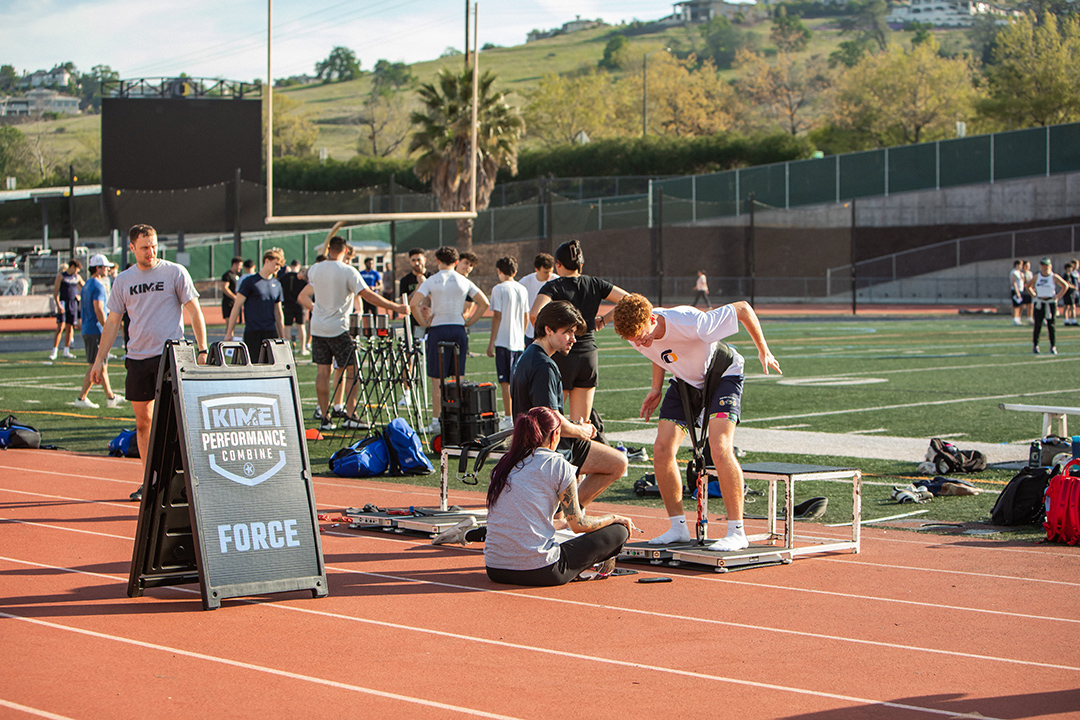
A typical return-to-sport visit, in most clinics, is a conversation. How does it feel. Can you walk without pain. Can you jog without pain. Cleared. The visit at KIME looks different. It is a screening battery, a video review, a force-plate session, and a sport-specific cutting and throwing assessment, performed on a turf surface large enough for the athlete to actually move at the speeds and angles their sport demands. The facility was built for that reason. You cannot evaluate an elite cutter on a clinic carpet.
And the visit ends with a number, or a set of numbers, that the athlete and the family can hold against the standard. Not “you feel ready,” but “you are at 92 percent of your previous propulsive power on the involved side, your ground contact time is within range, and your reactive strength index is within five percent of pre-injury baseline.” That is a return-to-sport decision. The other version is a guess.
The case to clinicians.
If you work in sports medicine and you have read this far, you already know what we know. The standard of care in our profession is moving. The clinician who can integrate kinetic linking principles, force-plate data, slow-motion video review, and sport-specific load testing into the return-to-sport decision is doing a fundamentally different job than the clinician who is still anchored to absence-of-pain as the clearance criterion. The data exists. The tools exist. What is missing is the willingness to raise the standard.
Three thousand athletes is enough to draw conclusions from. What those conclusions tell us is that “healed” was always a feeling, that the better athletes have always been the better compensators, and that the injury that comes back almost never comes back the same way. It usually comes back on the other side.
The work, then, is to stop measuring what the athlete feels and start measuring what the athlete can do.
Listen to the full conversation on KIMEcast Episode 59 — Return to Sport vs. “Healed.” To learn more about KIME’s screening protocols, Fellowship program, or to refer a patient, visit our website.
Recent Blogs
Archives
Kimecast Channels


